Research
I have given a couple of presentations about my research aimed at the general public. If you would prefer an explanation of my research aimed for the non-specialist, please look at my Presentations page.
In my PhD, I simulate the melting of ice mélange using computer models. Ice mélange is a mixture of icebergs and sea ice which floats in front of some of Greenland’s largest glaciers. One example is Helheim Glacier which flows into Sermilik Fjord in southeast Greenland.
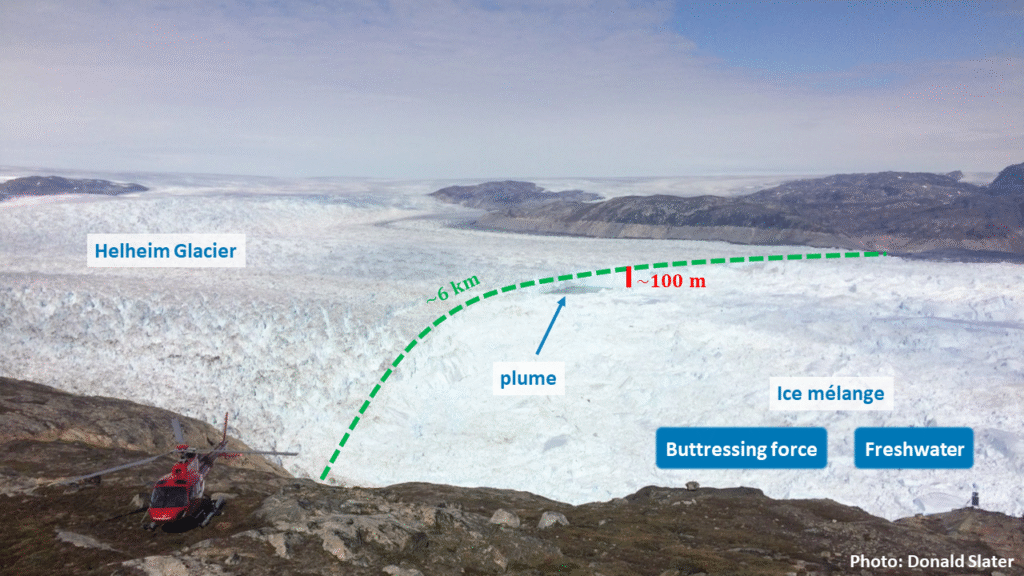
Helheim Glacier and its ice mélange, southeast Greenland. In the image above, the glacier flows from top-left to bottom-right and crashes into the rubble of icebergs and sea ice which is its ice mélange . A subglacial discharge plume is visible at the front of the glacier – this is where glacial meltwater released at depth has risen to the surface. Photo taken by Donald Slater.
As a glacier flows into the ocean, it crashes into the ice mélange. The presence of ice mélange has two key impacts on a glacier and its fjord:
- It pushes back against a glacier like a cork in a bottle, preventing icebergs from calving off the front.
- It melts and releases lots of freshwater, impacting the circulation of water in the fjord.
Understanding the melting of ice mélange is therefore very important: the more it melts, the more freshwater it releases into the fjord; and the more it melts, the thinner it becomes, reducing how much it can push back against a glacier and limit the ice lost.
I investigate the melting of ice mélange using computer simulations. In particular, I use the ocean model MITgcm to run simulations of how water flows around icebergs in order to estimate how much icebergs melt. By systematically changing the environmental conditions (e.g. ocean temperature, subglacial discharge flux (broadly linked to atmospheric temperature)) and mélange geometry (e.g. how thick the ice mélange is) in each simulation, I am able to investigate the sensitivity of ice mélange melting to different variables.
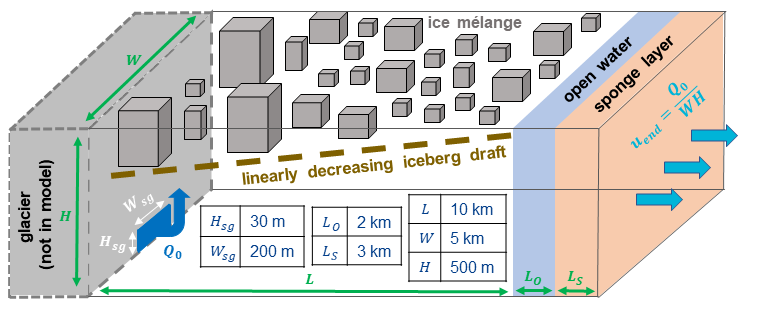
An example of a model setup in MITgcm used to investigate the melting of ice mélange. Figure from Jain et al. (2025, in review).
An example of a MITgcm simulation. This is a 2D plan-view slice at 100m depth of a 3D simulation. The grey squares are icebergs and the water colour represents water temperature. Visible on the left is warm water being upwelled (dragged up) from below due to the glacier melting at depth. This warm water makes its way slowly through the maze of icebergs, facilitating their melting.
I am in the process of developing a parameterisation for ice mélange melting as a function of environmental conditions and mélange geometry. This will hopefully allow us to incorporate the melting of ice mélange in larger scale climate and ice sheet models in order to reduce the uncertainty in future sea level rise.